

Delivering Personalized Experiences: An overview
Delivering a personalized experience that is both instant and deeply relevant is a significant technical challenge. Contentstack’s composable DXP, powered by Data & Insights (Lytics) and the Personalize engine, enables this through an edge-based personalization architecture.
Note:This is a simplified, high-level overview intended as an introduction to Contentstack DXP’s personalization architecture. For a complete end-to-end reference, including detailed diagrams, SDK examples, and API specifications, see the E2E Personalization Delivery Guide.
Technical Architecture
This overview explains how Contentstack DXP integrates with personalization tools to deliver seamless, real-time experiences. The architecture illustrates the collaboration between Contentstack CMS, Data & Insights (Lytics), and Personalize, ensuring users receive tailored content efficiently and at scale.
Understanding the Personalization Flow
- Data & Insights (Lytics) for tracking user behavior and determining audience membership.
- Contentstack Personalize for managing experiences, variants, audiences, and personalization rules.
- Personalize Admin UI or the Personalize Management API for creating and managing experiences and rules.
- Personalize Edge API for determining active variants in real time using configuration synced from the Admin/Management API.
- Contentstack CMS for creating and storing entry variants.
- Contentstack Delivery API (CDA) for retrieving personalized content.
This integration adjusts each user’s content experience based on their audience membership and profile data, while maintaining low latency and global scalability.
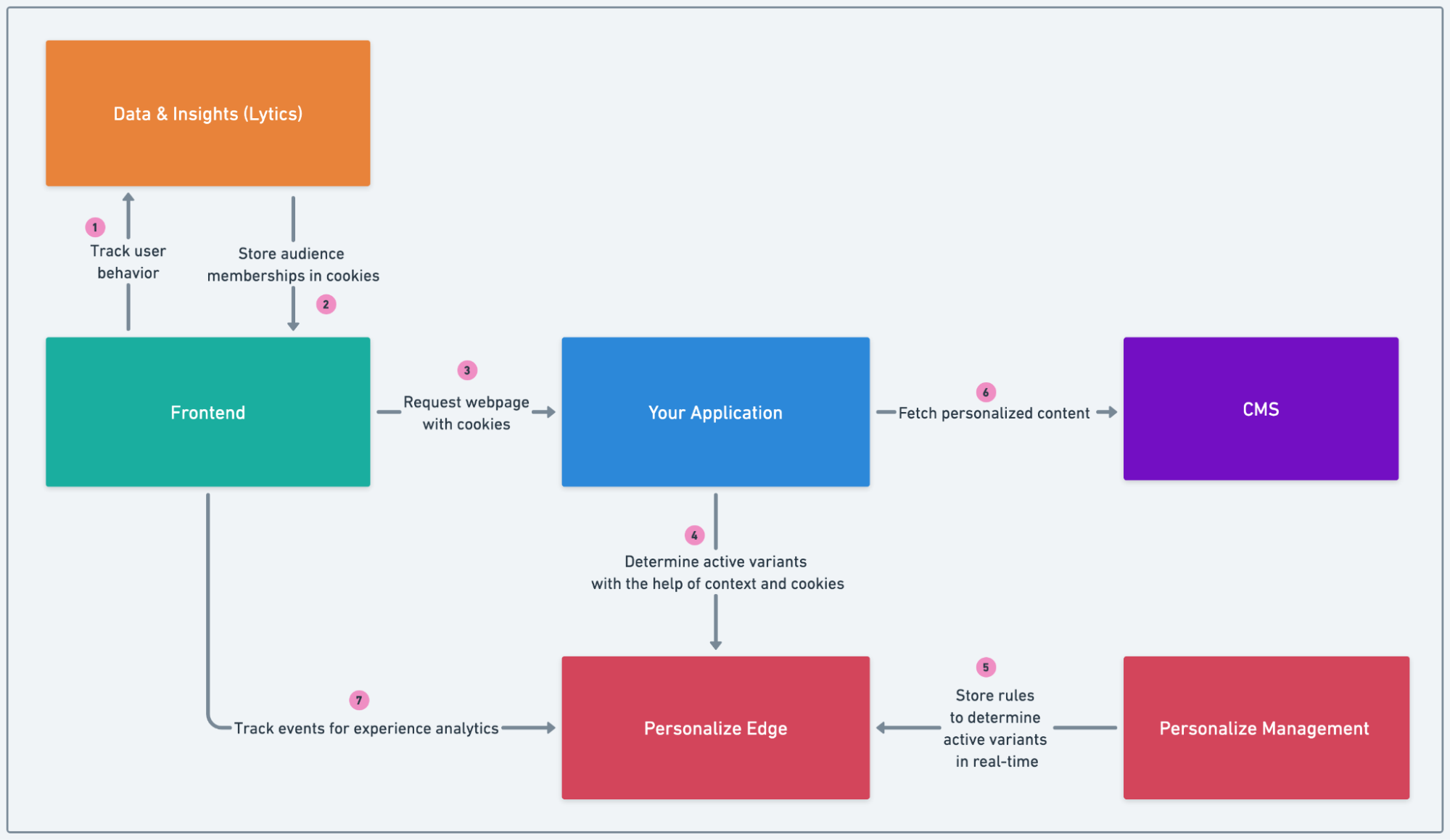
Data Flow Overview
User Data Collection - Data & Insights (Lytics)The Lytics JS Tag embeds on the webpage begins tracking user behavior such as clicks, navigation paths, and dwell time.
The tag also automatically collects page views, referral sources, user agent information, and other standard behavioral data. You can send additional user traits or attributes with the jstag.send() method. The Lytics JS Tag then syncs this data to the Lytics backend, which processes it to determine audience membership (e.g., Returning Visitor, High-Intent Shopper, Subscribed User).
- Set Audience Membership Context in the Browser
The Lytics JS Tag then pulls the audience membership information back into the browser and stores it in cookies, which are used by subsequent personalization APIs to drive personalized content decisions.
- Page Request
When the user requests a page from your application server, the request includes the audience membership cookies.
This contextual information becomes part of the personalization flow.
- Fetch Active Variants from the Personalize Edge API
Your application, preferably an Edge Function, calls the Personalize Edge API, ideally using the JavaScript Edge SDK.
The SDK passes the audience membership data from cookies to the Edge API for variant calculation.
- Active Variant Calculation
The Personalize Edge API calculates the active variants for the user.
All experiences, audiences, and rules created in Personalize Admin are synced to and stored at the edge. This enables real-time personalization globally without depending on the origin.
The Edge API uses these rules, along with audience membership, to determine the appropriate active variants for the visitor.
- Content Fetching from the Contentstack Delivery API (CDA)
Your application, typically the origin server, calls the Contentstack Delivery API (CDA) and passes the variant aliases returned by the Personalize Edge API.
The CDA returns the corresponding personalized entry variants from Contentstack CMS, which your application then assembles into the final response.
Note: Entry variants must be configured in the CMS. Refer to the Variants documentation for guidance.
- Tracking Events
After personalized content is rendered, track the performance of your experiences by triggering impression and conversion events from the browser.
These events power Experience Analytics, enabling you to measure effectiveness and optimize your personalization strategy.
By combining audience intelligence with edge-based decisioning and structured content delivery, Contentstack DXP delivers content tailored to audience context. Use this framework to guide your next steps in building personalized journeys.
Next Steps
Technical Overview of "Setup Personalize"
