What customer journey analytics reveals about your audience


Discover how customer journey analytics tracks every step your customers take across multiple channels, uncovers hidden pain points and delivers personalized experiences that increase loyalty and ROI. You no longer have to focus on guesswork to drive smarter decisions. You can start your analytics journey with Contentstack.
Highlights
You’ll learn about why you need customer journey analytics to understand the full customer journey:
- Real-time visibility into customer behavior across all channels
- Faster issue resolution by spotting friction points instantly
- Deeper personalization based on data-driven insights
- Improved ROI by optimizing marketing efforts
What if you could see every step your customer takes across multiple touchpoints before they make a purchase decision? What if you knew why they abandoned their cart, clicked your competitor’s ad or became a brand advocate?
That’s the power of customer journey analytics. It’s a data-driven approach to mapping and understanding how customers interact with your brand across every touchpoint, from the first click to post-purchase loyalty.
Why does it matter so much for customer experience initiatives?
Because customers don’t follow a straight line. According to a McKinsey report, over 50% of customers use three to five channels during a single purchase journey.
In this article, we define what customer journey analytics means, how it differs from traditional analytics and how businesses use it to convert insights into action and viewers into loyal customers.
What is customer journey analytics?
Customer journey analytics (CJA) is the process by which you analyze the customer experience (CX) across all your touchpoints, including online, face-to-face and in-store. Instead of only using clicks and the website, customer journey analytics tools connect data from social media, customer service calls, emails and other channels to paint the full picture of a customer's interaction and experience.
The primary goal is to understand customer expectations and behavior regarding a particular product and to know the opportunities to improve the customer experience. CJA can include analysis of:
- Customer’s emotional highs and lows
- Customer needs and pain points
- Customer satisfaction score and other survey results
- Key metrics during every step of the customer’s journey
undefined
After understanding what it means, let’s understand the difference between CJA and traditional analytics:
Customer journey analytics vs traditional analytics
| Aspect | Traditional analytics | Customer journey analytics (CJA) |
| Definition | Look at the success and failure of each channel or contact point. | Outlines every step customers take before and after buying, using all channels. |
| Focus | Channel-level performance (e.g., email opens, website clicks) | A commitment to making customers happy at each interaction and session. |
| View | Fragmented/siloed | Holistic, cross-channel and chronological |
| Time sensitivity | Uses historical data | Real-time or near real-time analysis |
| Goal | Optimize individual touchpoints or campaigns | Understand and optimize the full customer experience |
| Data source | Website analytics, campaign reports, CRM | Integrated data from web, mobile, email, call center, social, IoT, etc. |
| Insights provided | Business-centric (what we did) | Customer-centric (what they experienced) |
Now that we know how customer journey analytics differs from traditional analytics, knowing the difference between CJA and customer journey mapping is equally essential. While these terms are often used interchangeably, they serve very different purposes.
| Aspect | Customer journey mapping | Customer journey analytics |
| Definition | A visual representation of the steps customers take when interacting with your brand | A data-driven approach to tracking and analyzing customer behavior across touchpoints |
| Purpose | Identify key moments, emotions and friction points in the customer journey | Measure and optimize performance across the entire customer lifecycle |
| Data basis | Typically qualitative (based on personas, interviews and assumptions) | Quantitative (based on actual behavioral and transactional data) |
| Scope | High-level, strategic view of typical journeys | Granular, real-time view of individual or segmented customer behaviors |
| Output | A static journey map or diagram | Dynamic dashboards, reports and insights |
| Use cases | Align internal teams, design better experiences and identify friction | Track conversions, personalize experiences, reduce customer churn and attribute marketing impact |
| Time sensitivity | Typically created periodically or as part of planning cycles | Real-time or near-real-time updates from live customer data streams |
| Who uses it | UX designers, marketers and customer experience teams | Data analysts, marketing ops, IT teams and CX leaders |
Benefits of customer journey analytics
You become more customer-centric
The main aspect of customer journey analytics is improving how customers feel, not how companies want to perform. Noticing how customers interact with your company every step of the way allows you to make wiser and more empathetic decisions. Since your focus is on customers, you provide better services and better products, and keep loyal people coming back.
You can track issues as and when they happen
Rather than relying on outdated reports or lagging metrics, journey analytics gives you real-time visibility. When something goes wrong, like a broken checkout or a confusing email, you see it immediately. That means you can fix issues fast, before they cost you customers.
You improve customer experience
If the customer journey is well mapped, spots where customers face frustration are more obvious. Addressing a laggy site or a difficult-to-use mobile platform can improve the customer experience. As a result, customers feel better about their experience and tend to return.
Your customer lifetime value increases
Paying attention to how customers move through your journey helps you connect with them as time progresses. Being reliable in your service and providing what customers ask for when needed helps people trust you and encourages them to come back. These methods allow you to convert one-time customers into loyal customers, increasing lifetime value.
You ensure higher personalization
CJA helps you see what each customer wants and where they are in their journey. With that insight, you can personalize content, offers and messaging that feels natural and helpful. The better the personalization, the better the response.
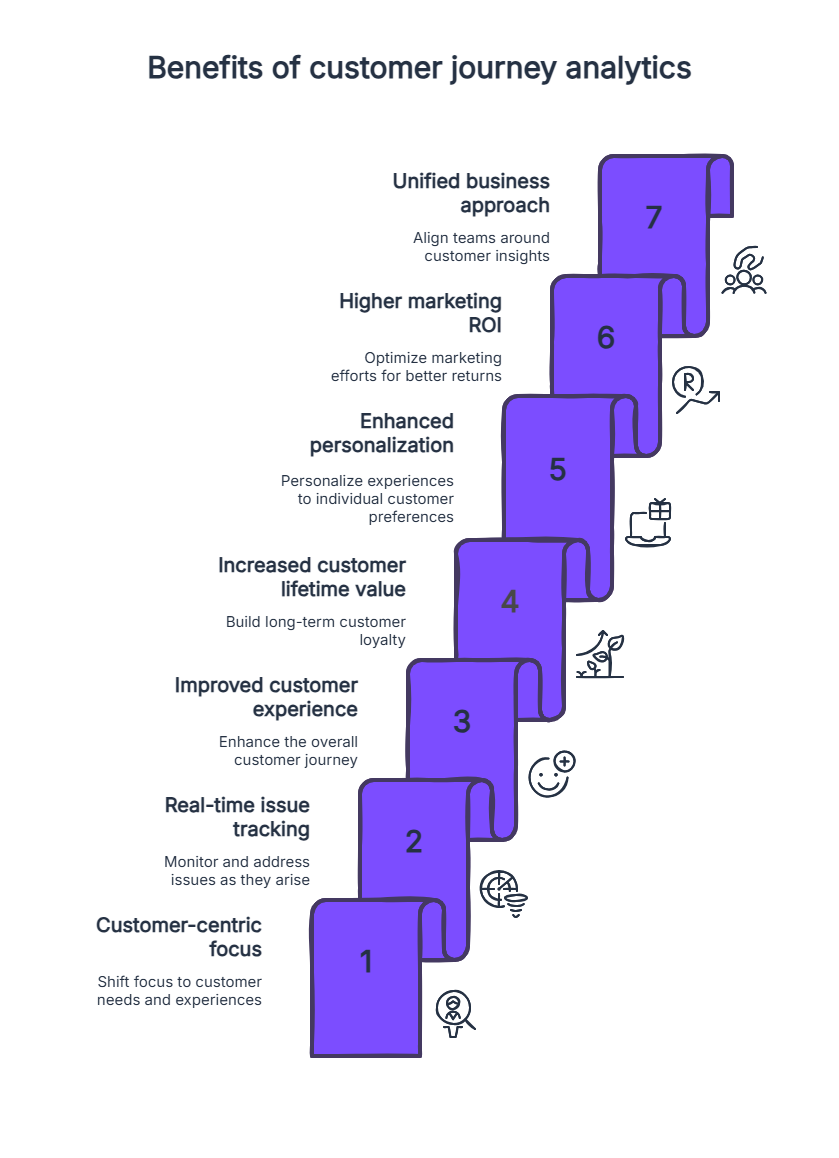
Your marketing ROI increases
Instead of making educated guesses with your budget, use customer journey data to drive data-driven decision-making and reduce wastage of money. Real customer actions can guide how you fine-tune your campaigns. As a result, marketing targets people more likely to buy, more conversions happen and every marketing dollar goes further, thereby improving marketing ROI.
You make your business more unified
When customer data is siloed across teams, you miss your customer’s journey. Knowing your entire customer journey brings marketing, sales, support and product teams together around shared insights for a deeper understanding of customer needs. Everyone works toward the same goal of delivering a consistent customer experience.
You ensure customer personalization
Personalization isn't just about using someone’s name in an email. It’s about relevance. Journey analytics uncovers intent, context and preferences so you can customize experiences for each user. Such personalization increases engagement and deepens customer relationships.
How journey analytics builds stronger customer relationships
Journey analytics helps you see the full picture of your customer’s experience and use that insight to make every interaction more personal, more relevant and ultimately, more meaningful.
It gives you the whole story
Instead of looking at a single moment like a purchase or a click, journey analytics connects all the dots. It shows how someone found your brand, what steps they took along the way and where they might have dropped off.
It shows you where things go wrong
Ever wonder why people abandon their carts or stop responding to emails? Journey analytics spots those friction points, like a confusing checkout page or a slow-loading app, so you can fix them.
It helps you respond in the moment
With real-time data, you can adjust what customers see or browse based on their actions. For example, if someone’s browsing winter jackets, you can instantly serve them related recommendations or promotions.
It powers personalization that works
Journey analytics provides marketing emails with more detail than just “Hi [First Name]. If you know where they are in their journey, you send the right message, product or information.
It gets everyone on the same page
Marketing, sales and customer support all benefit from the actionable insights journey analytics provides. When teams share a standard view of the customer journey, it’s easier to deliver a consistent experience.
How Contentstack's EDGE makes sense of your customer journey analytics
If you're like most enterprise teams, your customer data lives in too many places, including marketing platforms, support systems, web analytics tools and more. Each holds some crucial information, but no one has all the information about the customer’s journey. That makes it impossible to understand how people move through your customer journey. Why did they bounce from your landing page? What made them convert? What turned them into loyal advocates? In the absence of connected data, you base your decisions on intuitions and guesswork rather than data.
That’s where Contentstack’s EDGE comes in.
It’s more than a headless CMS add-on because it’s a real-time personalization engine powered by machine learning. The platform is built to help you understand and improve every moment of the customer journey.
Here's how Contentstack assists you in customer journey analytics:
Gathering information about users as they use services
Your site, mobile app, emails and ads send data to EDGE, which then puts together a profile for each customer, without them ever logging in.
Smart audience segmentation
You can connect with customers based on their actions, likes or stage in the buying process. Do you want to market to people who stopped buying and those coming back? EDGE brings that ease of use.
Deeper customer insights
As Contentstack connects with different analytics platforms, you get much more than just numbers. You can identify trends, guess how people will react and recognize what matters to them in advance.
undefined
How does Contentstack help your marketing team?
With EDGE, your marketing team can stop working in the dark and start delivering better experiences faster.
One clear view of each customer
No more switching between platforms. Everyone from marketing to product to support can see and work on the same customer data.
Better predictions = better timing
Use real-time signals to know when someone’s ready to buy, likely to churn or open to re-engagement. When you predict customer behavior, you can keep customers happy and satisfied.
Personalized content, right when it matters
Thanks to the integration with Contentstack’s headless CMS, you can automatically show the right content to the right person at the right time.
Always be improving
Every customer interaction becomes a learning opportunity. You can change and test in real time to make the customer journey smoother and more effective.
Case study: How Industry Dive used real-time CDP to drive personalization, engagement and growth?
Industry Dive, a publisher of online industry-specific news, turned to a real-time Customer Data Platform (CDP) from Contentstack to gain deeper insights into its 16M+ readers across dozens of publications. Previously relying on broad analytics, Industry Dive lacked clarity on who was engaging with its content. With real-time CDP, the company created targeted affinity audiences, enabling personalized content delivery, increased reader engagement and better alignment with advertiser goals. The platform reduced campaign costs, optimized editorial strategy and achieved over 40% more conversions on specific campaigns, making CDP a strategic differentiator for content creation and revenue growth.
After using Contentstack, Robin Re, VP Marketing at Industry Dive, said:
“Before Lytics, we struggled to get a clear picture of our readers. Now we have much better customer intelligence about how people are engaging with our content and can use that information to drive smarter content recommendations and better experiences.”
Read the complete case study here.
FAQs
What is customer journey analysis?
Customer journey analysis (or analytics) tracks how customers interact with a company across all touchpoints and channels over time. Its goal is to understand customer behavior, identify pain points and discover opportunities to improve the CX and increase loyalty and growth.
What are the 5 main points of a customer journey?
While models vary, a common framework includes:
- Awareness: The customer becomes aware of a problem/need and your brand/solution
- Consideration: The customer researches and evaluates different options
- Decision/purchase: The customer chooses a solution and makes a purchase
- Retention/post-purchase: The customer uses the product/service and experiences its value
- Advocacy: The customer is delighted and actively promotes your brand to others
What are the 7 stages of the customer journey?
The seven stages of the customer journey are:
- Awareness
- Interest (actively seeking more information)
- Consideration/evaluation
- Intent (showing strong signals of intent to purchase)
- Purchase
- Post-purchase experience (onboarding, usage, support)
- Loyalty & advocacy
What type of data is used in customer journey analytics?
A wide range of data is used, including:
- Behavioral data: Website clicks, page views, app usage, feature adoption, email opens/clicks and content downloads
- Transactional data: Purchase history, order values and subscription information
- Demographic data: Age, location and job title (especially for B2B)
- CRM data: Sales interactions, lead scores and customer history
- Customer feedback: Survey responses (NPS, CSAT), support ticket sentiment and reviews
- Campaign data: Ad impressions and campaign engagement
Learn more
Companies generally do a poor job of letting teams access their customer data. When this happens, your marketing or sales team wastes a lot of time trying to guess the outcomes. Analyses are done on customer data separately and at all meeting and interaction points. From solving customers’ pain points to building long-term loyalty, CJA is what you need for a successful customer experience. To know how Contentstack can help you, talk to us.
About Contentstack
The Contentstack team comprises highly skilled professionals specializing in product marketing, customer acquisition and retention, and digital marketing strategy. With extensive experience holding senior positions in notable technology companies across various sectors, they bring diverse backgrounds and deep industry knowledge to deliver impactful solutions.
Contentstack stands out in the composable DXP and Headless CMS markets with an impressive track record of 87 G2 user awards, 6 analyst recognitions, and 3 industry accolades, showcasing its robust market presence and user satisfaction.
Check out our case studies to see why industry-leading companies trust Contentstack.
Experience the power of Contentstack's award-winning platform by scheduling a demo, starting a free trial, or joining a small group demo today.
Follow Contentstack on Linkedin

Recommended posts