Simple ways to grow your marketing automation ROI today


Marketing is constantly changing, but automation helps keep up. From easier personalization to smoother workflows, it makes your job more straightforward and more effective. Curious about how to improve your marketing automation ROI? Discover what it can do for your team.
Highlights
You’ll learn about the benefits of marketing automation ROI:
- Reduces costs by automating repetitive tasks
- Improves lead quality with better scoring and targeting
- Increases personalization to drive higher engagement
- Enhances accuracy and reduces manual errors
- Speeds up workflows for faster campaign execution
Marketing moves at a lightning speed. Trends change fast, and marketing best practices evolve even before you get a hold of them. What worked yesterday might no longer work today. As a result, you have to pay constant attention, and so do your competitors.
What’s worse is that you must manage project management, data analysis and operations for your marketing team to work effectively. It’s tough, requires a lot of effort and takes plenty of time to keep up with modern trends and best practices. With automation, your team has more time to focus on innovations rather than wasting their time on mundane tasks.
This results in higher marketing automation ROI. Companies are generating $5.44 for every $1 spent on marketing automation, which translates to an ROI of 544%. Do you still have second thoughts about automating your key marketing tasks?
You will learn what marketing automation is, how to measure its ROI and the key metrics to watch for in terms of ROI.
What is marketing automation ROI?
Marketing automation is a process that uses tools and software to automate tasks like emailing, lead scoring, sharing posts on social media and customizing content for different audiences. As an alternative, you can ensure your messages are sent only when appropriate for each person based on their behavior.
Automating your tasks allows you to focus more on marketing strategies, creative ideas and meeting business goals. It helps B2B teams manage leads that take a long time to sell, keeps potential customers interested and builds relationships for them.
It allows you to determine if the costs and efforts of using automated technology yield a significant return to your business. Is the number of leads increasing? Is your customer lifetime value high? Are you noticing a reduction in the time your team needs to carry out a task? If your earnings from automation are higher than what you spend on it, then your marketing automation ROI is delivering significant results.
When you calculate marketing automation ROI, your team creates more fruitful campaigns and provides you with data-based insights about the customer journey.
Overcome traditional CMS issues with Contentstack: Are you tired of slow development times and rising costs due to legacy monolithic suites? Contentstack offers a modern, component-based solution designed for the needs of today's enterprises. Discover agility and improved ROI. Request a demo to learn more.
Benefits of marketing automation for ROI
Saves cost through efficiency
Automation in marketing handles simple yet repetitive tasks such as sending messages, labeling leads and posting on social networks. When you perform fewer manual tasks, you require fewer resources, saving costs.
Ensures better lead management
Not all leads are ready to buy right away. Automation tracks behaviors, scores leads and follows up quickly. That means you're spending your time and budget on the people most likely to convert, increasing the return you get from every campaign.
Personalizes marketing campaigns
Using automation, you can send messages depending on what your customers clicked, watched or downloaded. When every interaction is personalized for each shopper, engagement grows, more people convert and ROI improves.
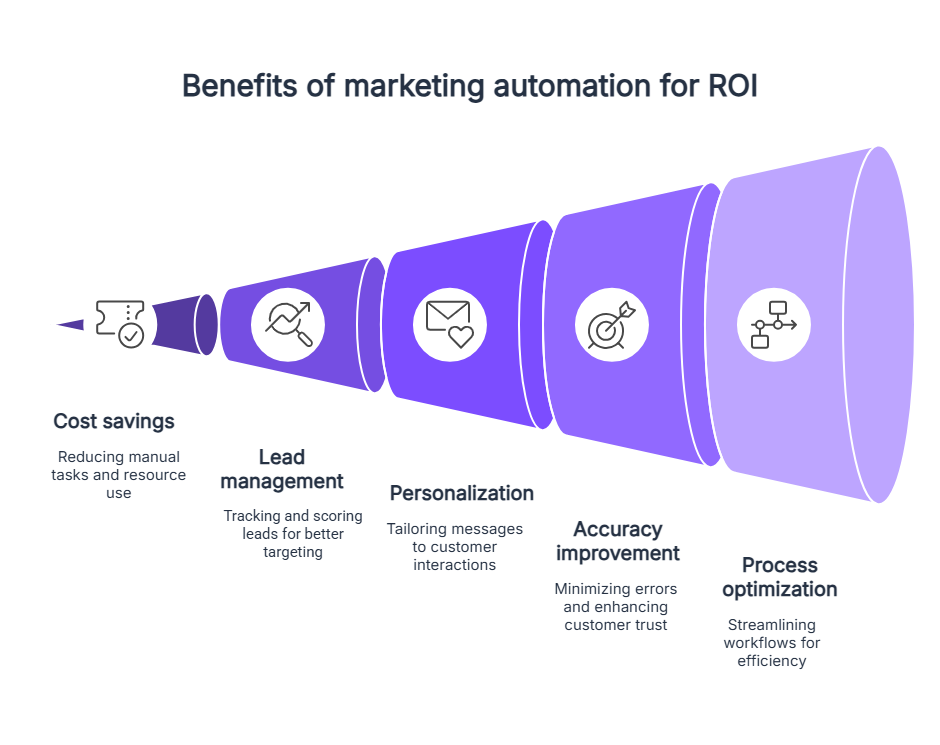
Improves accuracy and innovation
Automated workflows reduce the risk of human error, like sending the wrong email or missing a follow-up. More accuracy means better customer experiences and stronger trust. It also helps you get creative.
Optimizes your processes
Marketing automation platforms build cleaner, more consistent workflows. Instead of juggling tools or doing things manually, everything from lead capture to follow-up is connected and runs smoothly. When your marketing processes are optimized, your team spends less time troubleshooting and more time focusing on strategy—that kind of efficiency results in higher ROI.
Key metrics for measuring marketing automation ROI
Conversion rate
Conversion rate measures how many of your leads are signing up, requesting a demo or becoming customers. Through this metric, you can determine whether your automation is moving prospects through the funnel. A higher conversion rate from marketing automation shows the effectiveness of converting your leads into paying customers.
Customer acquisition cost (CAC)
The next metric to measure the success of your automation ROI is customer acquisition cost (CAC). CAC measures how much you’re spending to bring in each new customer. If automation helps you lower that number, you’re on the right track. Higher-quality leads and lower CAC indicate a good ROI.
Customer lifetime value (CLV)
The customer lifetime value estimates how much a customer will spend with your company throughout their time with you. With marketing automation, more personalized messages and offers get customers to continue buying, upgrading or renewing their services. When your lifetime value goes up, each customer is more valuable, and your automation is doing a great job of growing your business for the long haul.
Customer retention
Trying to retain customers is usually easier and earns more profits than having to consistently acquire new ones. Sending automatic reminders and follow-ups helps keep your customers interested in your business. If you track retention, you can notice how well the automation process sustains business growth.
Time to conversion
Time to conversion measures the time it takes a lead to convert into a customer. Shorter time to conversion often reflects the efficiency of your marketing automation processes in nurturing and converting leads.
Engagement rate
Engagement rate reflects how many people in your audience interact with your online content. Do they check their email, use your links, enjoy your videos or have contact with your content? A high engagement rate means your automated campaigns are capturing attention and keeping prospects interested. It’s a strong indicator that your messaging is relevant.
Lead-to-customer conversion rate
The purpose of the lead-to-customer conversion rate is to analyze how many leads end up becoming paying customers. It collects leads for you and provides insight on the effectiveness of your automation until the lead becomes a customer. Should your lead-to-customer conversion improve, automation encourages the right leads to move along and close more deals efficiently.
How Contentstack’s headless CMS supports marketing automation
To make the most of marketing automation, you need a content system that can keep up. That’s where a headless CMS like Contentstack comes in. A headless CMS is a content management platform that stores, organizes and makes content publishing easy across channels. In marketing automation, the right CMS does more than just manage content, as it delivers content faster and at scale.
Here’s how Contentstack supports smarter, more effective marketing automation:
Seamless content integration for campaigns
When you use Contentstack, you can manage your content in one place. You can connect it to your emails, landing pages, websites or mobile applications. As a result, your content and ads will be the same across social media platforms.
Easier personalization through dynamic content
One of the main reasons marketing automation brings high ROI is due to personalization. You can easily ensure the right message reaches the right person, relying on their behavior, position or other relevant information. Using dynamic content blocks, changes happen automatically to meet the requirements of each viewer.
Better collaboration between marketing and sales teams
Your marketing team, content creators and developers can cooperate without overriding each other's work. Being able to change document versions, use custom workflows and approve documents ensures teamwork. As a result, you and your team can get things done more smoothly and quickly.
Streamline workflow for faster campaign
In automated campaigns, speed to complete the task matters the most. Because of the tools available in Contentstack, you can make and publish new content more efficiently. As a result, your automation process stays flexible and can adjust in real time for any action or development.
Centralized customer data for smarter decisions
Since Contentstack can be used with real-time CDP, analytics or marketing automation software, you have a better idea of how well your content is performing. The unified data helps you make smarter decisions, optimize campaigns and continuously improve your automation strategy.
IDC MarketScape recognizes Contentstack's excellence, naming us a Leader in Headless CMS by IDC MarketScape, Contentstack demonstrates a future-proof CMS strategy, R&D pace in innovation, and exceptional customer delivery. Discover how we can elevate your digital experiences. Request a demo to learn more.
How to improve your marketing automation ROI
Focus on personalization
One-size-fits-all messaging was a craze in the early 2000s, but today, digital customers expect personalization. Only when you tailor your messages based on individual customer behavior, past purchases and history do you increase your ROI. Making customers feel as if they’re in a one-to-one marketing funnel encourages them to spend more. Personalization increases the overall value of your marketing automation program.
Use AI
Artificial intelligence (AI) is a necessary part of your marketing automation system. Using data analytics, it becomes possible to predict what customers will do based on past and present trends. Consequently, you can send emails when your audience is more likely to act, improving your open and conversion rates. AI can help make your content more relevant using natural language mechanisms. It helps you understand the people you are communicating with, which makes your writing more relatable.
Improve lead scoring and nurturing
Not all your leads are equal. Using marketing automation, divide your prospects into high-potential leads and those with a lower likelihood of converting. After that, use automated workflows to direct each prospect through the sales funnel, achieving better conversions and ensuring optimal use of your marketing budget.
Monitor and optimize your ROI metrics
Maximizing your ROI requires constant improvements. And that begins with identifying the right performance metrics. Monitoring and optimizing your performance metrics helps you see what’s working and what needs improvement. Regular audits of your workflows uncover underperforming segments. Based on your marketing campaign’s cycle, review the performance monthly or quarterly.
Marketing automation mistakes that decrease ROI
You’re using dirty data
24% of companies report poor or insufficient data as the most significant barrier to the adoption of marketing automation. Poor-quality data costs brands money and time because they take action based on inaccurate information. This leads to lower engagement numbers, damages your reputation and you end up losing leads. For your automation to be successful, you need to work with clean data.
You fall into the trap of over-automation
Though automation is powerful, it can backfire. Whenever everything is handled through automation, customers notice the interaction feels cold and impersonal. If you rely too much on automation, you might miss opportunities to interact genuinely with your customers. You need to balance automation with human insight. Leverage marketing automation to scale, but retain a layer of personalization and strategic oversight. Regularly audit workflows to stay relevant and add value.
You are integrating the wrong marketing automation tools
Some tools are better than others. Running your campaigns on an incompatible system can result in inefficient workflows, limited functionality and ineffective results. Working with complex tools may not be easy for your staff. Ensure the tools you select are adjustable, easy to use and work with your other tools. Select a platform that you can link to other apps, offers useful analytical information and provides responsive customer service.
Your marketing and sales teams are not aligned
When your teams do not collaborate, communication becomes messy, chances are overlooked and customers may be frustrated. Your marketing automation fails. Marketing may generate leads that sales doesn’t follow up on, or worse, leads that aren’t qualified. This reduces conversion rates. Better collaboration between teams with shared goals, unified KPIs and regular communication can help you avoid these issues.
FAQs
What is ROI in marketing automation?
ROI in marketing automation refers to how much profit you make by investing in marketing automation approaches and tools.
How do you calculate ROI for automation?
Subtract the total cost of your automation investment from the revenue attributed to it, then divide by the total cost.
What is a good ROI for marketing?
While ROI benchmarks vary, a higher ROI signifies better profitability and efficiency.
What are KPIs in marketing?
KPIs track main metrics, including the number of conversions, the average lifetime value a customer provides and the performance of each campaign.
Learn more
Getting the most out of your automation tools is best achieved by looking at your return on investment (ROI). Marketing automation covers much more than simply saving effort. It’s all about working more intelligently, focusing your actions more effectively and making them more successful. Properly used email marketing helps you build relationships with the right group at the right time. And the best part? It pays off. With the right tools, clean data and strategic thinking, you can increase your ROI. Platforms like Contentstack combine everything so your content, campaigns and customer experiences are consistent. Talk to us to know how Contentstack can help.
About Contentstack
The Contentstack team comprises highly skilled professionals specializing in product marketing, customer acquisition and retention, and digital marketing strategy. With extensive experience holding senior positions in notable technology companies across various sectors, they bring diverse backgrounds and deep industry knowledge to deliver impactful solutions.
Contentstack stands out in the composable DXP and Headless CMS markets with an impressive track record of 87 G2 user awards, 6 analyst recognitions, and 3 industry accolades, showcasing its robust market presence and user satisfaction.
Check out our case studies to see why industry-leading companies trust Contentstack.
Experience the power of Contentstack's award-winning platform by scheduling a demo, starting a free trial, or joining a small group demo today.
Follow Contentstack on Linkedin

Recommended posts