The State of the CMS Industry: 20 Key Content Management Statistics for 2020


Content management is nearly as old as the internet itself. For most of its history, WordPress has dominated the choice of content management systems (CMS)—but is that poised to change in 2020?
Furthermore, how will the rise of technologies like AI, chatbots, and headless CMS impact the industry?
Moreover, will the increase of voice-activated search and smart devices impact the platforms we rely upon to manage content?
Read on to learn more about where the CMS industry is going in 2020 and to discover a few surprising statistics about trends you should watch closely.
The State of the CMS Market in 2020—And Beyond
WordPress may still loom large in the CMS market, but growth and shifts in the industry could leave openings for new, more-tech savvy players.
- Globally, the CMS market was valued at around $36 billion in 2018 and is expected to generate around $123.5 billion by 2026—which is a very healthy compound annual growth rate (CAGR) of nearly 17 percent.
- 33 percent of that growth is expected to come from North America.
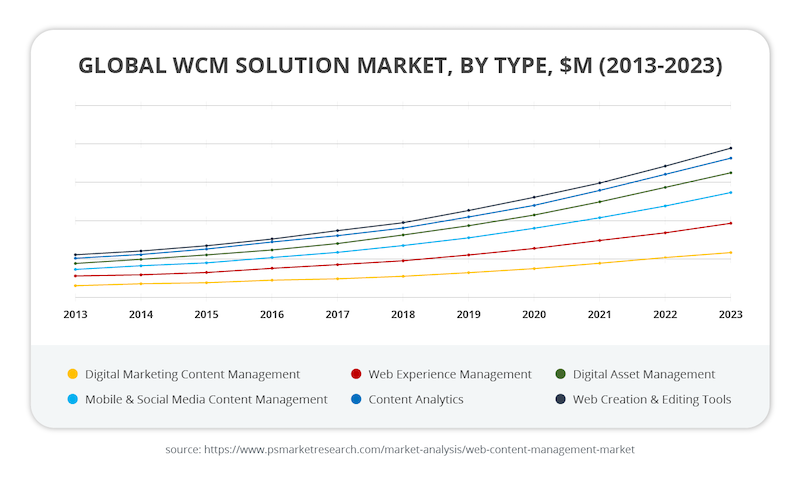
It is also essential to consider the global web content management (WCM) market, which includes related tools such as content analytics, digital asset management, and editing tools.
- In 2017, the WCM industry was valued at around $4.8 billion and is expected to reach over $11 billion by 2023, amounting to a compound annual growth rate (CAGR) of 15 percent.
- While CMS remains the most significant portion of the industry, web experience management solutions make up a growing portion of the market.
Key factors that impact the CMS industry's growth include an increase in demand for digital marketing solutions, a growing digital retail sector, and consumer demand for omnichannel experiences.
- As of 2018, WordPress powers 34 percent of all the websites on the internet.
- Joomla powers 2.8 percent of all websites while Drupal powers just under 2 percent of all sites. Squarespace, often touted as a top competitor to WordPress, is used by just 1.6 percent of all websites.
It is worth noting that the vast majority of the market is made up of content management systems that capture less than 1 percent of the total market—which means that there is plenty of room for growth of alternative solutions.
Content Management Fact Sheet: The Importance of CMS
At their core, a CMS is designed to allow multiple users to manage content and make it easier to display that digital content. As technology changes, CMS and related systems like digital asset managers (DAM) can improve security, make sites more user-friendly, and even save money.
- 33 percent of marketing budgets go towards technology, with 28 percent of that total budget going to infrastructures such as CMS and web content management systems.
- 92 percent of companies face challenges in translating content into different languages. Only 29 percent of companies integrate their CMS with a translation management system or language service provider
- 91 percent of customers want to pick up where they left off when they contact a customer service rep, no matter what channel they use.
As technology advances, digital publishers are looking to cut costs, and DAM systems could be the answer.
- The average worker spends 20 percent of every day looking for lost files. The cost to replace a single digital asset can easily exceed $1,000—which can make a DAM system quite a cost-saver.
Security issues remain a struggle for content management systems, with WordPress getting the most flack. This is not to say other content management systems don't face security issues, but as the most popular CMS, WordPress does have the most concerning numbers.
- The platform's worst security breach impacted 18 million WordPress users.
- As many as 70 percent of all WordPress sites may be vulnerable to hacker attacks.
Key CMS Trends You Need To Know
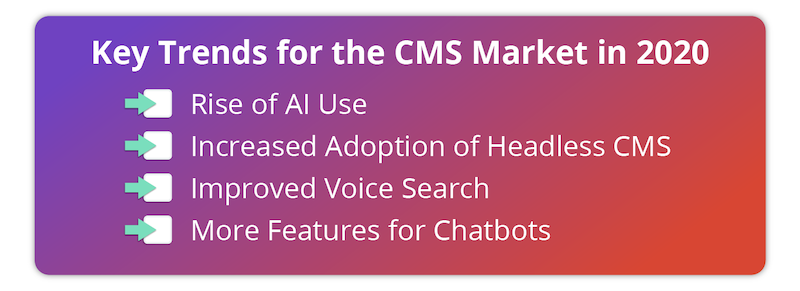
Looking ahead, what changes can you expect in the CMS industry? Headless CMS and AI are a few of the top content management trends to keep an eye on. Here is what you need to know about these and other CMS trends.
Use of AI in CMS is Rising
Drag and drop and WYSIWYG editors may be falling out of favor as AI takes over. Several content management systems, such as WIX, are already using AI to make it easier than ever for users to build, create animations, and even create copy for their websites.
According to CMSWire, AI could help CMS generate content, design sites, speed up testing, and even give feedback on content.
- IBM predicts by the end of 2020, 90 percent of large enterprises will be running pilot or production-level machine learning applications.
- By 2020, nearly 20 percent of business content is going to be created by AI.
Increased Demand for Headless CMS
The core goal of a CMS has always been to make it easier to manage content without digging into coding. However, as we look to 2020, content-driven services and websites are consistently moving to headless CMS solutions to adjust to the rapidly diversifying content consumption landscape.
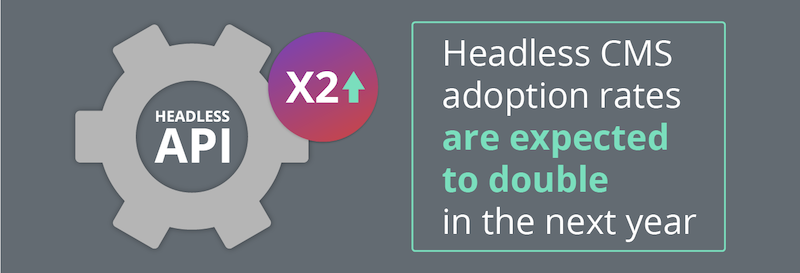
- Headless CMS adoption rates are expected to double in the next year.
- 86 percent of people feel positive about headless CMS.
- 63 percent of people who use a headless CMS love it.
Better Assistance for Voice-Based Search Optimization
Voice search made its debut in 2007, but most content management systems have largely overlooked it.
Most systems offer SEO features for traditional (read: typed) searches. However, the voice search industry is fast growing and worth paying attention to.
- So far, in 2019, consumers have spent over $2 billion through voice-based online shopping. The voice shopping market is expected to exceed $40 billion by 2022.
- By some estimates, half of all searches may be done by voice in 2020.
- By 2040, 95 percent of all purchases will be done online.
Increased Need to Manage Chatbot Content
The rise of chatbots is another trend those paying attention to the CMS market should keep an eye on. The way a CMS manages content needs to adjust to serve the demands of automated chatbots better, as Gartner predicts:
- Chatbots will power as much as 85 percent of all customer service conversations by the year 2020.
- By 2020, the average person is going to have more conversations with a chatbot than their spouse.
Ready to Learn More About the Future of Content Management?
These are just a few of the CMS trends that are influencing the way brands and publishers use content management in the coming years.
As more internet users become publishers, many content management systems are changing to become more user-friendly and less code reliant. However, a CMS must also be able to adapt to new content types and technologies. The systems that do this well, such as headless CMS, may be poised to take over market share from WordPress.
Learn more about how headless CMS is changing the face of internet publishing in The Ultimate Guide to CMS, volume 1.
About Contentstack
The Contentstack team comprises highly skilled professionals specializing in product marketing, customer acquisition and retention, and digital marketing strategy. With extensive experience holding senior positions in notable technology companies across various sectors, they bring diverse backgrounds and deep industry knowledge to deliver impactful solutions.
Contentstack stands out in the composable DXP and Headless CMS markets with an impressive track record of 87 G2 user awards, 6 analyst recognitions, and 3 industry accolades, showcasing its robust market presence and user satisfaction.
Check out our case studies to see why industry-leading companies trust Contentstack.
Experience the power of Contentstack's award-winning platform by scheduling a demo, starting a free trial, or joining a small group demo today.
Follow Contentstack on Linkedin

Recommended posts